The book you’re reading was written using the methods described in this book.
Not a metaphor. Literally. 4 AI agents wrote drafts in parallel. 3 different roles did independent reviews. One human made architecture decisions and served as final arbiter. The harness constrained quality. Multiple agents cross-validated output. Memex supplied the raw material. Every principle from the first six chapters was executed during the writing of this book.
This is the hardest validation I can offer: if the methodology works, it should be able to produce the very artifact that documents it. If this book reads well, the methodology holds. If it reads poorly, the methodology isn’t good enough — at least not for writing.
This chapter breaks down that process.
1. Material Layer: 227 Cards Aren’t Notes — They’re Externalized Engineering Judgment
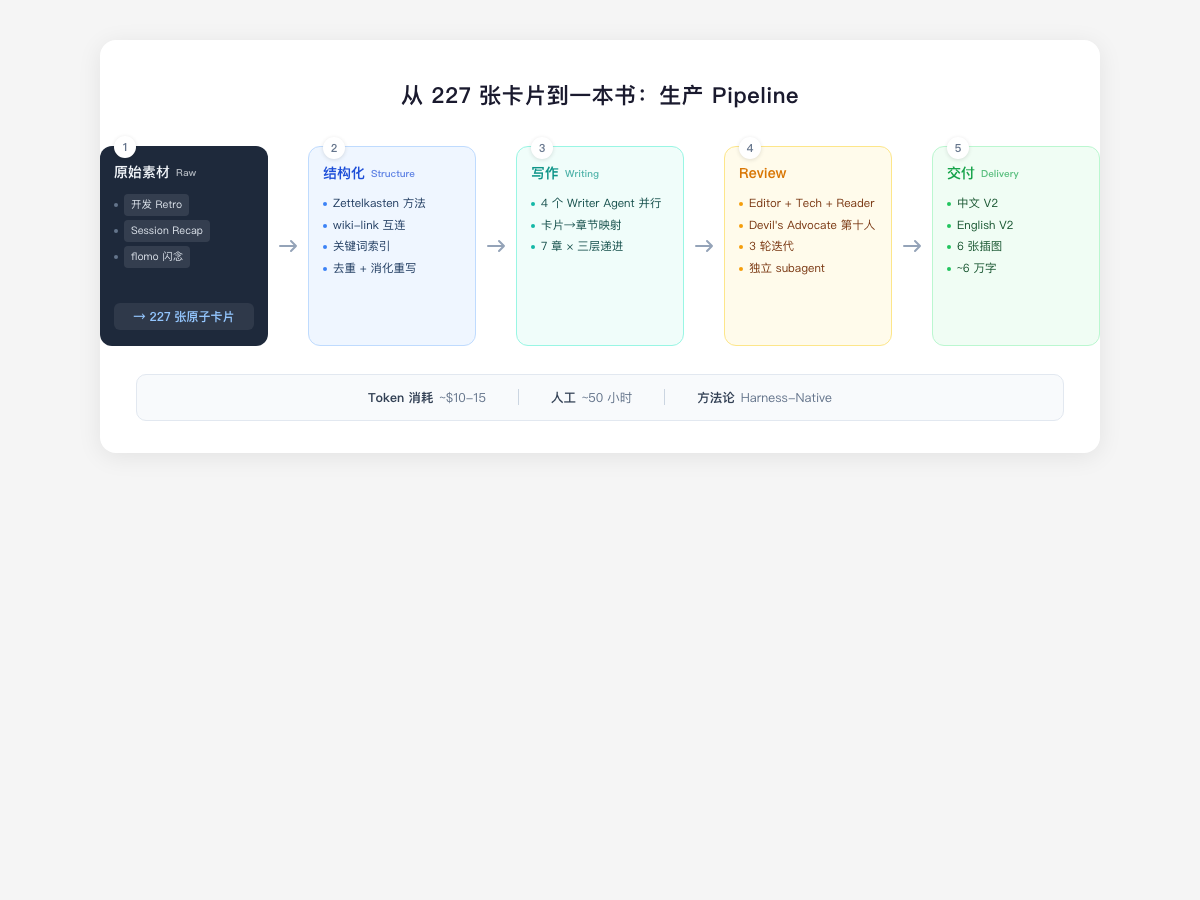
Chapter 1 already covered in detail why Zettelkasten beats vector databases for agent memory. I won’t repeat the methodology here — just how it played out in the book-writing scenario.
227 cards are the entire raw material for this book. They weren’t written for the book — they’re atomic records left behind between September 2024 and April 2026, every time I hit a bug or made a key decision. Each one backs a specific bug, a specific failure, a specific insight. The sources were multi-channel: most were written directly into memex, but a significant portion started life in flomo — fleeting ideas during walks, late-night aha moments while reading papers, post-mortems after arguments with colleagues — later filtered, structured, and migrated into the memex card system. flomo is the capture outpost; memex is the repository for sedimentation. One optimizes for speed, the other for structure.
Around card 100, clusters started to emerge. “Test trustworthiness” had over a dozen cards. “AI agent failure modes” had twenty-plus. “Git and deployment” had nearly thirty. I didn’t design these clusters — they reflect the problem domains I kept running into in practice.
By card 150, links between clusters started forming higher-level structures. “Test trustworthiness” and “AI agent supervision” had heavy cross-linking — because verifying the quality of AI output is fundamentally a testing problem. That insight became the backbone of Chapter 2 (Harness-Native Engineering).
This is the power of Zettelkasten: you don’t need an outline from the start. Write enough atomic cards and the outline emerges on its own. You’re not writing a book — you’re waiting for the book to emerge from the cards.
2. Structure Layer: Three-Step Convergence from Clusters to Chapters
Step 1: Identify Clusters via memex search
memex search by tag and keyword sorted the 227 cards into roughly 12 clusters. Some cards belonged to multiple clusters — that’s the benefit of atomicity; cards aren’t locked into a single chapter.
12 clusters corresponded to 12 potential chapters. But a book can’t have 12 chapters — merging and cutting was needed. The final structure: a preface plus 7 chapters across three progressive layers — foundation, methodology, application. Each layer required a different cluster-merging strategy.
Step 2: Find the Narrative Arc
Within each cluster, the links between cards form a subgraph. What I looked for was the narrative arc of that subgraph — in what order should a reader digest these cards?
The method is to ask one question: “If a reader could only read 5 cards from this cluster, which 5 and in what order?”
That question forces you to do two things: select (what’s core, what’s supplementary) and sequence (what comes first, what comes later). Selection determines the chapter’s scope. Sequencing determines the chapter’s structure.
There’s a subtle tension here: 227 cards are “data” — tag frequency, link density, cluster size are all quantifiable signals. But which cards go into which chapter, from what angle to develop them, how to shape the narrative arc — these depend on intuitive judgment. Bezos has an observation: when data and frontline intuition conflict, it’s worth investigating the intuition signal first — because data loses critical dimensions through aggregation, while intuition is a compression of high-dimensional perception.
The writing process validated this repeatedly. Some cards looked peripheral by link data (referenced only once or twice), but my gut said “this one matters.” Digging in, I’d find it captured a cross-cluster insight that simply didn’t have enough related cards yet for link density to show up. Conversely, some high-frequency topics (like “prompt engineering techniques”) had strong data signals, but intuition said they lacked lasting value — two months later a model update would make them obsolete.
This isn’t to say data is useless. Data is the starting point: cluster emergence, link density, tag distribution help you quickly survey the landscape. But what ultimately determines a chapter’s direction is that sense of “there’s a pattern here worth digging into.” Data tells you the terrain; intuition tells you the direction. For irreversible structural decisions (should this chapter exist? is this the right angle?), give intuition more weight — it’s a one-way door, and the cost of backtracking is high.
Step 3: Multi-Agent Parallel Expansion into Draft
With the core cards and sequence in hand, expanding into a full chapter wasn’t a solo job — it was handed off to a Silicon Team of writers. That’s the next section.
3. Production Line: 4 Writer Agents + 3 Role Reviewers + 1 Human Architect
This is the most meta part of the book: the writing process is a direct reuse of the methodology from Chapter 3 (Multi-Silicon Empowerment) and Chapter 4 (Autonomous Operation).
Parallel Writing: 4 Writer Agents
Each chapter’s first draft was generated in parallel by 4 independent writer agents. All 4 received the same input — the cluster’s core cards, narrative arc, target reader profile, tone requirements — but their sessions were completely isolated.
Why 4 instead of 1? Same reason as the Spawn model in Chapter 3: session isolation produces independent perspectives. Given the same set of cards, different agents choose different entry angles, different expansion orders, different case study emphases. 4 drafts aren’t 4 copies — they’re 4 variations.
My job was to pick the best skeleton from the 4 variations, then transplant good paragraphs from the other versions. This is much faster than writing from scratch, and produces much higher quality than using a single agent’s output.
Three-Role Review: Editor, Technical Reviewer, Reader
After each chapter’s draft was complete, it entered 3-role review. Three reviewer agents evaluated independently:
- Editor: Text quality, structural pacing, consistency with the rest of the book
- Technical Reviewer: Accuracy of technical descriptions, authenticity of case studies, precision of terminology
- Reader: Is it engaging? Do I want to keep reading? Would I recommend it to a friend?
The three roles’ sessions were also isolated — reviewers couldn’t see each other’s feedback. This is the independent review principle from Chapter 2: reviewers must not contaminate each other, or they converge toward groupthink.
Each role flagged issues with a severity system, sorted by priority, and the results merged into a single review report. Then I, as the human architect, arbitrated — which changes to accept, which to reject, which needed further discussion.
This three-role review process is exactly what the chapter you’re reading went through. That’s how meta this gets.
The Human’s Role: Architect, Not Typist
Throughout the entire pipeline, I did exactly three things:
Material selection: Choosing which of the 227 cards go into which chapter. AI doesn’t know which lessons are most valuable to readers because it lacks the intuition for “who is the target reader.”
Opinion formation: Every engineering judgment — “auth and data access must be separated,” “smoke tests must include functional verification” — was formed through my own practice. AI can help me articulate an opinion clearly, but the opinion itself doesn’t come from AI.
Cutting and tone: AI tends to keep everything (more content = more complete). I cut roughly 40% of the draft content. AI defaults to neutral politeness; this book demands a first-person voice that’s direct and aggressive — hedging stripped, assertions in. Cutting and tone are the core of creation. AI can’t do that.
A Real Example: How Chapter 4 Went from Cards to Chapter
Take Chapter 4 (Autonomous Operation) as an example. Its cluster contained 28 cards covering micro-management vs macro-delegation, tick budget, termination conditions, the OPC pipeline, and more.
memex search --tag autonomous --tag pipeline pulled out the trunk cards first. Then link traversal surfaced related cards — “convergence check” linked to “test trustworthiness,” “tick budget” linked to “resource management.” These cross-links helped me discover causal relationships within the chapter: you have to understand the harness (constraints) before you can understand why it’s safe to let an agent run autonomously.
4 writer agents each produced a draft. Agent 1 opened with a narrative of a day in OPC. Agent 2 cut in with a “three phases” framework. Agent 3 led with a specific failure case. Agent 4 started with an industry comparison. I went with Agent 2’s framework (three-phase progression was the clearest), but transplanted Agent 1’s OPC pipeline passage and Agent 3’s tick budget case study.
The 3-role review caught a key issue in this chapter: the technical reviewer flagged that “convergence check still requires a human in the loop” needed qualification — under what conditions? Is partial automation possible? That feedback directly led to the final version’s analysis of the “plan decomposition → execution → verification → convergence check → auto-termination” chain.
From 28 cards to final draft, the entire process took about 6 hours. 4 hours were AI working (parallel writing + review), 2 hours were me making decisions (picking the skeleton, transplanting passages, arbitrating reviews).
4. Economics: Tokens Are the Cheapest Factor of Production
The entire book’s (preface + 7 chapters) AI token consumption from card retrieval to final draft:
- Card retrieval and clustering: ~50
memex search/readcalls → ~100K tokens - Parallel draft generation: 4 writer agents per chapter × ~8K tokens output average → ~230K tokens
- 3-role review: 3 reviewers per chapter × ~6K tokens average → ~130K tokens
- Revision iterations: ~3 human-driven revision rounds per chapter → ~140K tokens
Total: approximately 600K tokens, API cost roughly $10–15.
That number says one thing: the bottleneck isn’t generation — it’s judgment. Money spent on AI was $15. Time I spent was dozens of hours — selecting, sequencing, cutting, adjusting tone, ensuring technical accuracy, arbitrating review disagreements. AI is cheap enough to ignore. Human judgment is the scarce resource.
This is consistent with the conclusion from Chapter 4: the bottleneck of autonomous operation isn’t execution — it’s convergence check. The bottleneck of book-writing isn’t writing — it’s judging what to keep, what to cut, what to change.
5. Closing the Loop on Methodology
Look back at the whole process. It maps directly to the four causal chains of this book:
Harness → Autonomous → Empowerment → Output.
Harness layer: The card format (YAML frontmatter + wiki-links + tags) is the writing harness — it constrains every piece of raw material’s structure, ensuring agents can parse and process it unambiguously. The 3-role review process is the mechanical gate — it doesn’t rely on agent self-discipline but uses process to guarantee quality.
Autonomous layer: 4 writer agents writing in parallel, 3 reviewer agents evaluating independently — these are autonomous operations. I’m not in the loop watching each agent’s every output. I design the pipeline, hit start, wait for results.
Empowerment layer: Each agent didn’t just receive a task like “write Chapter 4.” It received a complete capability package — core cards, narrative arc, tone requirements, target reader profile, full-book structural context. This is the capability empowerment from Chapter 3 — not assigning work, but arming the agent.
Output layer: One person + a Silicon Team, a few dozen hours, one book. Not because I type fast, but because I’m not in the loop — the same logic behind the “90 minutes, 21 work units” throughput from Chapter 4.
The better the constraints, the greater the freedom. The card format constrained material quality. The harness constrained agent behavior. The review process constrained output standards. Precisely because the constraints were good enough, I could hand off book-writing to a Silicon Team for autonomous execution.
But closed loops are also traps.
Naval has a mountain-climbing metaphor: you summit the first peak, the view looks good, but the higher mountain is on a different ridge. To get there, you have to descend first — give up your current elevation — before you can climb higher. Most people refuse to descend because sunk cost feels too real. This is path dependency: past success locks in your future perspective.
V1 of this book was that first peak. V1 established the framework — from Zettelkasten to multi-agent, from harness to autonomous operation — and once written, the structure was self-consistent, the logic formed a closed loop. But the closed loop itself was a lock-in. V1’s 187 cards defined the problem domain’s boundaries. V1’s chapter structure defined the narrative path. You start unconsciously “filing” new experiences into the existing framework, rather than letting new experiences challenge the framework.
V2 was a deliberate descent. The 40 new cards weren’t just “more material” — some directly challenged V1’s assumptions. Integrating them wasn’t about “adding paragraphs” to existing chapters; it was about re-examining whether each chapter’s core claims still held. Some held but needed qualification. Some needed rewriting. Some needed entire structural reorganization.
This is also why I deeply resonate with the idea that “reading a hundred books deeply beats skimming a thousand.” TL;DR-style shallow knowledge — reading summaries, watching crash-course videos — feels like accumulation but actually deepens path dependency. You use old frameworks to quickly “understand” new information without ever truly letting the new information shake the old framework. The value of deep reading and deep practice is this: they make you uncomfortable, they make you discover you were wrong. Growth mindset isn’t “I’m willing to learn new things” — it’s “I’m willing to invalidate old things.”
Final Words
This book started with 227 cards, went through search → cluster → parallel draft → 3-role review → human arbitration, and became the 7 chapters + preface you’re holding.
Methods are the lever. Experience is the fulcrum. Behind those 227 cards are thousands of hours of engineering practice — bugs hit, decisions made, patterns recognized. That time can’t be replaced by any tool. AI can turn 227 cards into a book, but it can’t help you accumulate those 227 cards.
In the preface I said: by the end of this book, you’ll have a harness design framework, a multi-agent collaboration methodology, and a new way of thinking. You’ve finished reading. Whether these things are now yours — that depends on what you do next.
Don’t read more books. Start practicing.
Write your first card. Hit your first bug. Design your first harness. Launch your first Silicon Team.
One person, one Silicon Team. It starts here.